Showing posts with label counters. Show all posts

Mar 31, 2014

Kitchen Remodel MUSTS

When you're ready to redo your kitchen, there are a number of things you should consider so your investment in cost and time is done right.  It's worthwhile to meet with a kitchen designer so you can maximize your space, your budget, and get enduring changes without skimping on what's important to you.   If you do a remodel and don't include a feature that you didn't think about, you'll regret it. Understanding materials, care and maintenance, technology and even trends are important both short and long term.

In a typical kitchen remodel, regardless of whether the budget is small or large, your percentages for spending will look something like this:


8-10% Electrical & Plumbing

14-16% Appliances
16% Walls, ceilings, floors, doors and windows
29-30% Cabinets and hardware
10% Counters
22% Planning, design and installation

You should visit showcase homes, model homes, showrooms, and think about the pros and cons of your existing kitchen.  You might find that you love specialty appliances like wine centers and pot fillers, but when you consider the cost, amount of use, and space required, they may not be worth the splurge.  Some things that you might think are over-the-top but are value added in the long run are second sinks, finished cabinet ends and shelves and drawers on full extension glides. In the Carlsbad kitchen above, I was able to include a host of useful appliances, carefully placed and concealed for a luxurious end result. Every cabinet was detailed to provide maximum use of space and finished so they blended seamlessly with the furnishings in the adjacent rooms.


Appliances can be tricky to select. Sure stainless is cool, but can you get features you like without the up-charge?  If you're  planning to conceal them, Do you need a professional grade appliance and the changes in counter depth, venting and ductwork that are required?  Is a dishwasher or refrigerator drawer a pro or a con? What refrigerator style works best for you and do you need to sacrifice interior space for an in-door water dispenser?  New cooktops offer fabulous features so be sure to check out options like induction.


Counter top materials get better every year. Granite is NOT the luxury surface it used to be. Quartz has many PROS and few CONS over stone, and the appearance is often more beautiful. Solid surfaces have new styles and benefits and the costs are often more reasonable than stone. Integrating sinks into counters is a huge plus. Combining counter materials like Cynthia Ryan did in this modern space is stylish and functional.


Don't forget to add space for recycling and composting.  Most areas of the country are actively participating in programs now, and more will make it mandatory for household food waste. 

Good lighting is KEY in every kitchen. Know local codes for lighting and be smart in using good, correctly lamped (the right bulb) fixtures. Understand the value of LED, florescent and even incandescent lighting and which works best in specific places in your kitchen.  Technology is your friend in lighting design and control, and a small investment enables a money savings and aesthetically fabulous long-term results. These Arts & Crafts fixtures are all warm LED and toe kick lighting accents the cabinetry around the peninsula serving as guide lights.


Know that there are  many flooring options and learn which is best for you. Wood, porcelain, vinyl, cork, ceramic and even linoleum have PROS and CONS for performance, durability, cost to purchase, install and maintain.  Wood is $8-40 per square foot installed but has performance and care drawbacks. Porcelain is $11-25 per square foot installed but colder underfoot. Cork is warm and $10-20 installed but does need occasional to coating. Linoleum has the best value at $4-8 installed, with beauty and design like never before, but seams are a must in large spaces.


Cabinetry is the usually the most expensive part of a remodel. Is wood better than laminate? Can you upgrade your look yet lower costs with veneers? Should use a custom fabricator or buy manufactured?  Understand the finishes and what will be more durable for your type of use. Antiquing and distressing is beautiful but not always worth the splurge. Consider that open shelves may be easier and better than closed door cabinets.  Be SURE that your interior fittings work for your lifestyle.


Plan a layout BEFORE you buy anything or demolish what you have. It may be better to change the position of your plumbing, gas lines and dedicated oven and fridge receptacles. It was key in this Coronado kitchen for me to relocate the gas line  for ideal work flow and a balanced kitchen. 


 Don't start without having all of your products in hand. Finding a sink you love only to find that it's back-ordered for weeks can wreak havoc with your life and the rest of the kitchen project. 


Jul 5, 2012

Must-haves in kitchen design.

We all love to look at new designs and check out the trends. We can use them in our own homes and be smart and savvy in our design.  However, there are some essential elements that make a kitchen truly comfortable to live and work in.  Here are my top 10:


1. Make the floor comfortable.   A mat by the prep area, sink, bake counter, or stove will keep knees and backs more comfortable.  Cork flooring does that naturally, but area rugs and specialty kitchen mats are a great addition to a finished kitchen.


2. Have the best lighting possible. Under and over-lit kitchens are not pleasant to work or be in. Task lighting where you need - over sinks, cooking surfaces and prep counters - it is ideal, and ambient lighting for general use works well for eating, re-stocking, cleaning and gathering. A combination of recessed and ceiling fixtures works well for most spaces; using LED and halogen bulbs on dimmers will provide clean, white light at the perfect level.


3. Keep surfaces clutter free with optimal storage. Rather than leaving oft-used items like spices, cooking utensils and small appliances out, find a handy place to stash them. When you need cooking space, having to move items around is cumbersome.  Tuck a narrow cabinet for spices next to the stove, create shelves for easy-reach of oils and seasonings, and make homes for appliances right where you use them. 


4. Make the distances between counters, appliances, sinks and key usable areas precisely right so there are no long reaches, easy access from one point to the other, and large enough not to feel cramped.


5. Update appliances that don't perform well. Having an inadequate dishwasher, a noisy refrigerator motor, or an oven that doesn't heat evenly, is stressful and likely not energy efficient. 


6. Add color for interest and to create a desired mood.  Spots of color, changes in color between the upper and lower cabinets or an island, and accent walls, can create energy and a focal point. 


7. Create a gathering area. It's often nice to have company when cooking, and an extra prep area is nice but not always possible, but place comfy seating nearby; a padded stool, great counter chairs, even a fold out bench!


8. Add a touch of personality.  Hang a favorite piece of art, a collection of your children's masterpieces, and place travel mementos on shelves. You might find that a collection of glass jars becomes a great display filled with kitchen staple items.


9. Bring in a plant or flowers.  Even a tiny apartment kitchen will feel warm and happy with a few flower stems tucked into a glass.  The greenery, the color, and the texture is relaxing and pretty.


10. Have one movable prep surface. In a small kitchen, preparing a large meal can take up all of your counter space. By having a large cutting board, you can take it anywhere and add a kitchen surface. In large kitchens, it's nice to have a rolling prep center for large meals, baking projects and more.  It can serve as an island every day, or roll into a pantry for use when needed.

Jun 4, 2012

Trends in Kitchen and Bath Design


It's important to know design and technology trends when remodeling your kitchen and bath. Kitchens can be costly, and it's smart to use the best quality products and maintain current code and technology standards. Aesthetics are as important as function, and understanding what's available will give you a long-term advantage for style, usefulness, and more. Since sustainability in purchasing, using, and ultimately discarding products, is a way of life, knowing what is 'green' and why will help you make the right decisions for your remodel.

The age of remodelers plays a tremendous role in design trends but is 'flattening out' as technology and aesthetics cross generational lines. 
For the first time ever, 4 separate generations—Gen Now (ages 15-34), Gen X (ages 35-44), Zoomers (ages 45-65) and Prime Timers (ages 66-plus)—are interacting, influencing and coexisting closely with one another. While each has its own set of needs, together they are reinventing the rules of what a kitchen and bath should be, whether it cater to youthful technology savvy, a passion for entertaining, the quest for wellness or the desire to age comfortably in place.  Sure "Zoomers" are opting for easy of use and maintenance and "Generation Now and X" opt for clean lines and high technology, but overall, kitchen and bath styles are moving towards sleeker lines - no ornate details - and simple outward appearances, with function that makes operation and use fast. Whether it's due to a busy lifestyle or arthritic joints, new cabinet hardware that enables automatic opening, remote controlled shades, and faucets that turn on when you place your hands underneath, are all products that are here to stay. Long-term value and quality are must-haves for any kitchen or bath, as durability is key for homeowners raising families, as much as for those who have resale value in mind. Aging in place elements provide fabulous function and aesthetics across generations, and will be key elements when selling a home. 
Black chrome faucets
Formica has a new look and edge styles.
A savvy new toilet by Kohler.
Adding color to a neutral kitchen is hot (literally).
Color is more earthy overall, yet mixing in bold color is new.  Plumbing fixtures remain popular in chrome, but new black and midnight chrome are gorgeous and enduring. Sinks are available in earthy browns, grays and with suede finishes, and vessel sinks continue to be an opportunity to add style and a unique focal point to bathroom design. Glass is beautiful as well as functional for vessel sinks and even kitchen counters. Grey and white are popular in natural stone tile and quartz surfaces, as well as appliances. I see products that enable a more personal design alternative. For example, updated quartz and paper - yes paper - countertops, glass backsplash tiles, and even Formica, have textures, colors, and patterns that will work well today as for the long-term. Cabinet colors lean towards white and ivory, but dark stains are still in vogue.  White tubs, toilets and sinks are still king in the bath. Blending with large format porcelain tile in deep gray, makes an elegant and easy care statement.

Integrating products seamlessly into the spaces remains a top trend. From refrigerators that blend right into the overall cabinetry to drawer inserts that provide quick access to hard-to-reach spots, these new storage solutions generated new, unexpected openings for work spaces. Concealed kitchen shelving and extra-wide sinks boasting functional colanders and cutting boards within were also heavily featured, as storage possibilities spread from not only closets and the garage but to the kitchen and bath as well.

  Advanced technology from products that include smart phone applications to designs that mix light and sound in the bathroom. Toilets can now determine how long you’ve been sitting, or open the lid as one walks toward it, and even wall sockets are built smarter to incorporate direct USBs plug-ins for consumers using laptops and charging their phones in the hub of their home, the kitchen.

Once a buzz term, “green” has become engrained in the kitchen and bath industry. What began as an appeal for eco-friendly products and materials in the home has now transformed into holistically sustainable spaces that encourage healthy living behaviors by those inhabiting them. Designers, architects and manufacturers alike are rethinking the word “green” to encompass a complete lifestyle, and as a result, its definition has expanded to include descriptors such as “authentic,” “American made,” “character,” “local” and “organic.” It's now easier than ever to go green. High-efficiency toilets and showerheads are the norm and can easily be installed or retrofitted in any home. Recycling has even become easier, with compactors that can silently crush cans installed right into kitchen cabinet space. Technological advances like motion sensor faucets and lighting have become more sophisticated, helping to save both water and energy. 

Jun 1, 2012

Awesome tile for your bath

We don't like to use the same tile for a client - EVER. So, seeking out new products, suppliers, and styles is our forte. Take a look at the ones we've found for our showroom! Come by and take a look!


Jul 29, 2011

5 Designer ideas to update your kitchen.

When you want to add a little bit of glamour to your kitchen, try these ideas:


1) Use a detailed edge on your counters. Whether you elect to use a double rolled edge of stone on the island, or a beefy 2" edge to your quartz, the look will be elegant and dramatic. 


2) Dim all of your lights. Place all recessed and other fixtures on dimmers so you can create ambiance when all of your prepping is over.  


3) Build your electronics in. Add receptacles, cables, etc.. in for laptops, phone charging and TV and video watching. Having them in a central location can assist with homework, cooking practice and on-line research.


4) Add furniture touches to your cabinets.  By upgrading basic cabinets with details like scroll legs, inlays, and veneers will enable the kitchen to blend more seamlessly into your decor.


5) Provide glamour with lighting and fabrics.  Rather than use a basic fabric on your chairs and barstools, use a durable, stain resistant acrylic.The patterns and colors of sun-resistant fabrics are dynamic and you can have a plush velvet with easy clean-up. Opt for a chandelier with glass or metallic elements over the island or to anchor your table. Glamour has never been easier to obtain.

Jul 21, 2011

White baths - timeless and classic


Transitional style.
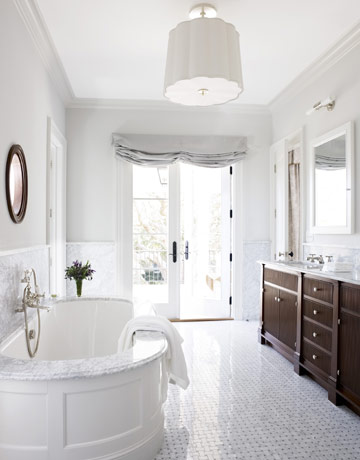
With so many options in stone, porcelain and ceramic tile, we don't often think of the design possibilities using white. Using textures, varying scale, and changing the shades of white in tile and slabs, can create dramatic baths whose designs stand the test of time. Using accent hues in cabinetry, mirrors, and lighting, a white bath will be timeless.  With classic elements, these baths demonstrate how stunning simply white can be.
Classic and traditional.
Cottage casual and minimalist yet comfortable.
Classic and elegant with cabinetry as the accent hue.

Jul 12, 2011

Should you use stone or not?


When selecting surfaces for your floors, walls and counters, also consider the long-term cost of maintenance. With a huge variety of color and size options, the cost to purchase install your surface, as well as costs to maintain should be the determining factors for selection.  Here is a brief guide to surfaces and their care:

 Recommendation from the designer: Porcelain tile and Quartz counters are two of the most durable, easy care, competitive cost alternatives.  For both, the selection of colors, ways to use, and overall performance are fantastic. The options in porcelain tile sizes and styles are ever-increasing, with trim tiles to finish edges. I prefer porcelain and quartz to their natural stone counterparts.

1) Granite: Porous, igneous stone. Tile and slab available. Must be sealed annually in baths, more often in kitchens. Stains and etches. Don't let oils or vinegars sit on surface too long. Great heat resistance. Be aware that some colors have radon. Not impervious to bacteria. Clean with stone cleaner to avoid removing sealer or dulling shine. Don't use acidic products or shine can be dulled.


2) Quartz: (Silestone, Cambria, Caesarstone, etc..) Stone-epoxy composite.Tile and slab available. Non-porous so no sealer required.  Heat and stain resistant. High durability. Often embedded with antibacterial compound. Clean with almost any household cleaner. Some versions by Silestone are 'green'. Colors can be stone-like or unique in pattern and particulate.  This bath uses a fossil-like quartz in a soft white. 

3) Travertine-limestone-soapstone-marble-slate: These are all porous stone products that can be used on counters, floors and walls. Tile and slab available. They MUST be sealed often so water and products don't penetrate.  All are stainable and prone to scratches. Soapstone has good heat resistance. Requires regular cleaning with stone cleaner or neutral non-abrasive cleaner.  Products for ceramic tile may NOT be used on these stones. Soap scum is difficult to remove. Special products are available to help remove stains.


4) Porcelain: A subset of ceramic tile. Highly durable surface for floors, walls, and even counters. Generally through-body color with a glazed surface. No porosity. Clean with nearly any household cleaner. Recommend that you seal grout after installation for best stain resistance in high use areas. Patterns, colors, and sizes nearly limitless. Unique stone-like patterns available for more durable, easy care surface than real stone.


5) Ceramic: Made from clay or other inorganic materials, hardened by oven firing and usually coated with some kind of glaze.  Ceramic is easy to clean and doesn't harbor germs.


6) Solid surfaces (Corian, Corinthinan, Wilsonart, etc...) : Solid, manufactured with plastic or acrylic. Durable, non-porous, stain and bacteria resistant. Not heat resistant. Through-color and easy to buff scratches or make repairs. Often has integrated sink options. Seams are inconspicuous.