Showing posts with label style. Show all posts

Apr 17, 2013

Trends for the long-term.


What defines a trend? Take a look at the latest design magazines. You'll notice a 'new' classic is developing  It's called transitional style.  Furnishings and finish materials are being made with new design details, color and shape. A clean-lined style with an easy-care sophistication is the result. The details come from classic lines, updated patterns, use of bolder fabrics, and a new scale. From tile to seating to lighting, this is a trend that is here to stay.

             
From classic Hepplewhite oval back chairs in a new form. The attention to leg and back detail and use of crisp ivory fabric with a slight sheen, gives a stunning aesthetic and fabulous function.


A sleeker version of a traditional sofa, with squared-off arms in lieu of rolled, and tapered block feet. Classic and sophisticated yet very updated. With a textured green fabric that's not standard sage....gorgeous!


Silk drum pendants are more often replacing multi-armed chandeliers for transitional styling. The brushed nickel fittings and frosted glass diffuser add elegant detail.


A change for the better from wood burning to bio-fuel fireplaces. They provide warmth and a fabulous aesthetic with an eco-friendly benefit. With no special venting required, and a variety of sizes and materials, they can be installed in indoor and outdoor spaces.

Porcelain tile has come a long way. With elegant patterns and sheens, new sizes and trim pieces, and a huge array of colors and textures, US and Italian porcelain tile manufacturers have given us a new classic surface.
Making faucets lead-free, water saving and with universal design in mind, form does follow function. New finishes are luxurious and easy-care...what a great combination.

Certified woods are being fabricated into strand forms that are as elegant as they are eco-friendly. Luxurious color and grain, along with wide scale planks, make these floors right for nearly any style decor.

Apr 15, 2013

What's your style?

Do you know your style?   To be successful in selecting the materials and items to be used in your interior decor, your should know what your personal design style is. Why?  Let's use the example of going to buy a new car. When you walk onto a lot you're faced with cars in all sizes, colors, body types and features.  When you don't have an idea what you're looking for, frustration and confusion set in. If you opt for one that isn't right, unhappiness will pervade your life. For interiors that we don't change often, being happy in your home is essential. Selecting the right products and styles, enriches your life, satisfies and grounds you, and reflects who you are. Knowing your style and working your spaces with elements of that style will save time, money, and give you rooms that are exactly what you want. Here are my 5 favorite ways to help you find your style:
Arts & Crafts is clean and warm.

1) Look at professionally designed rooms:  Buy magazines and clip out images of rooms you like. You can do the same from on-line sources. Go to a library or bookstore and browse the design section.  In each image, look for things that please you; the color of the room, a particular piece, the feel of the design, a specific light fixture or treatment, or even the way the room looks overall. 

Cottage style. Casual and classic with, bead board, white hues, warm woods.
2) Visit furniture shops and walk through the room arrangements noting what you like.  You can ask questions of the sales representative or take brochures about the arrangements to help identify specific items.


3) Take a design style quiz.  These are more superficial but do guide you in overall style.  Putting a name to a style can often help you during shopping trips when you are able to ask for "a Neoclassic style lamp." Do back-up research through blogs, furniture, and design web sites


Traditional living room with antiques, rich hues, classic furnishings.
4) Attend local design shows, lectures, and events.  Your local chapter of ASID - The American Society of Interior Designers  - often schedules lectures and events for the public. Is there a show house nearby? Are there Home & Garden shows you can attend? Visit them and take notes. 

5) Call a local designer and schedule a consultation. To really hone in on your style and get immediate design advice, sit down for an hour or two with a design professional. It will set you on the right path and give you peace of mind when you start your project.

Dec 5, 2012

From then to now...


When updating your home, if you select furnishings with classic lines, the result will be an enduring style that won't need to be re-done for years.  I love to compare styles and see how they evolved over time. Three main styles are Traditional (Sheraton, the Louies, Tuscan, and similar), Modern (Eames, van der Rohe, Retro and the like) , and Transitional (elements from Traditional and Modern periods combined). Contemporary style simply refers to the current period.  Can you mix these styles? A resounding yes! A change of fabrics, mixing colors, and adding the right accessories, will help shape the overall style.


Sofas: Traditional sofas have many forms. A rolled arm, skirted base, and tufting on the back, is common. For a more modern feel, strip away the details, square off the cushions and arms, and a modern style is born. The tapered legs and exposed wood apron are classic and allows this sofa to work well with traditional pieces.


Tables: Despite the modern flair of the nested end tables on the left, their tapered leg and mahogany inlay top allow them to fit nicely into a traditional room.  The tripod leg table below is a Sheraton-styled piece that, with its brass coaster legs and carved details, is a classic, traditional table.
Chairs: Tapered legs, a shield back with carved wheat detailing, provide the dining chair on the left with clear traditional styling. With it's oval back and tapered legs, the second chair has a modern feel but the basic elements that comprise the chair are classic.


Cabinetry:  Modern style case goods have less detail and more boxy lines like the armoire on the left. Its Asian style and hardware make it right in traditional and modern settings.  The curio on the right is a traditional piece with a bow front, carved dentil molding and frieze relief on the doors. Perfect for a classic living room.

Oct 23, 2012

What's your style?


Arts and Crafts style. Clean lines, natural elements.
In order to be successful in selecting the materials and items to be used in your interior, you should know what your personal design style is. When you don't have an idea what you're looking for, frustration and confusion set in. For interiors that we don't change often, selecting the right products and styles, enriches your life, satisfies and grounds you, and reflects who you are. You will save time, save money, and have a home that provides rest, rejuvenation, and happiness. Use these tips to help define your style.


1) Look at professionally designed rooms:  Buy magazines and clip out rooms you like. Go the your local bookstore and browse the home and design section.  Look for things that please you; the color of the room, the feel of the design, a specific light fixture or piece of furniture, the way the room looks overall. Is there something that grabs your attention? The elements of styles that you like will become clear and help you add them to your design.


Cottage style. Casual and classic with, bead board, white hues, warm woods.
2) Visit furniture shops and walk through the room arrangements noting what you like.  Ask questions of the sales representative or take brochures about the arrangements to help identify specific items.


3) Take a design style quiz.  These are more superficial but do guide you in overall style.  Putting a name to a style can often help you during shopping trips when you are able to ask for "a Neoclassic style lamp." Do back-up research on-line through blogs, furniture and design web sites, and image searches. Identifying styles with names such as "Classic Bohemian" are of no use, however, because there aren't common elements associated with made-up names!


Traditional living room with antiques, rich hues, classic furnishings.
4) Attend local design shows, lectures, and events.  Your local chapter of ASID - The American Society of Interior Designers often schedules lectures on design for the public. Is there a show house nearby? Are there Home & Garden shows you can attend? Visit them and take notes. 

5) Call a local designer and schedule a consultation. To really hone in on your style and get immediate design advice, sit down for an hour or two with a design professional. It will set you on the right path and give you peace of mind when you start your project. At www.tot-home.com we provide in-home, in shop or on-line consultations for every client!

Nov 30, 2011

Ideas for small spaces.


Whether your small space is a bedroom, apartment, or home, here are five ideas to help you maximize the space you have:


One wall of shelves adds storage and opens the floor space.
1) Raise the heights of storage. Keep things off the floor and use taller pieces to make a small room appear larger. For example, a bookcase that spans the entire floor-to-ceiling distance makes a ceiling seem higher. Dedicating one wall to bookshelves that takes advantage of every inch, or using a large armoire or storage piece on only one wall, will make a room look bigger and eliminates the feeling of a cluttered space. Close off a few shelves with doors for neatness.  Stack file cabinets or chests (safety first) on top of one another rather than lining them up along the wall. Left a bed off the floor to add storage drawers, and if the ceiling is high enough, perhaps making a space underneath for a desk, lounge area or reading nook.


Loveseats make a narrow apartment comfy but not crowded


2) Use furniture wisely & make every piece count.  For a small living room use a backless chaise or daybed to divide adjoining space or functional areas; for example, separate the kitchen area from the family room or the living room from the dining room. Downscale your seating and even tables so you have the function you need while retaining an open feel. Try using a storage bench instead of dining or desk chairs to serve a dual purpose. Open backed shelves make great room dividers but look nice from either side. 


White works in this tiny bedroom with stacked storage.


3) Keep it light. While you don't have to use white paint, a lighter color background (floors, walls and even shelving) will help make a small room feel more open. Monochromatic color schemes are great for small spaces since they blur the boundaries between walls and furniture to make a space feel expansive. Don't hide windows, rather make them appear larger by placing window coverings above or to the sides. Position a mirror to capture light and reflect it back into the space.


4) Take it off.  If you can remove doors to rooms that don't need privacy...do.  Opening a small bedroom to a hallway makes the room seem more connected to the other spaces, may add light, and there are many uses for the doors so they don't need to be stored ( a desk top, a panel for an appliance, a new back to a bookshelf).  Hanging a curtain or beads instead provides a more open divider but eliminates door swings and maintains a more open feel.


5) Glass (or other transparent material :)) is your friend. Need a privacy divider but it blocks light? Tempered glass walls and door inserts allow light to pass through rooms but create privacy. New resin and plastic products with embedded designs are also available. Can't do a whole wall? Create a small interior 'window' or even an over-door transom to allow light in.  Glass tabletops help a room feel more open than wooden tops.

Jul 25, 2011

3 Bedroom updates with photos and directions.

Need to refresh your bedroom? With so many products and options available which do you choose?  Here are three bedrooms with directions for making the changes.  


Some simple changes transform this casual bedroom into a sophisticated guest retreat. The walls, once a pastel green, were refreshed with a light blue hue, and the white ceiling became a soft blue. Crown, base and doors moldings remained white. Adding a transitionally styled iron bed frame was the most significant change.  Draping inexpensive sheer fabric (less than $15 per yard) over the frame creates a soft, inviting place to sleep. Instead of the two-drawer nightstand, an end table - the same height as the mattress - provides a landing space, shelving for books and a clock, and its new open style fills the void next to the bed with just the right element. Adding a deeper toned area rug beside the bed rather than in the center of the room makes the room seem more open, and is better underfoot for guests. White big box store bedding, a yellow throw and brightly colored pillows in blue and complementary orange, finish the bed. Lighter artwork, all in the same transitional versus cottage style, refreshes the space and provides the finishing touch.


While this room looks significantly different, there are some shortcuts to be considered.  Purchasing ready-made shelves from a discount store, and tying them together with molding, is the largest change. They create a headboard with storage, end table function and additional space for lighting. Warm tones of beige on the wall and an area rug in the same hue, provide a warm backdrop for the new white trim and doors.  The doors, while hinged French doors instead of sliding wooden doors, can be created without the expensive price tag. Using reclaimed doors from a salvage yard is one solution, sustainable and cost-effective.  Another is to apply molding over inexpensive mirror squares to a slab door. Hinges are required here since the added dimension would not allow the doors to slide. Bedding remains white, but as with the accessories, the addition of blue accents, is the ideal contrast to the beige and white. A simple wooden bench completes the transformation.


Re positioning the bed in this space was key to the change. In front of the window, the bed took up less space in the room and the open weave headboard does not restrict light from entering.  The walls went from pale yellow to a deep ivory. Blue was the accent color in the 'before' space and became the feature color in bedding, bed drapes and pillows. An inexpensive "found" headboard separates the window and bed and enables pillows to be propped up, adding dimension and texture to the bed.  A Roman Shade lets more light in than the prior sheers and is tailored and neat.  The bed drape was constructed by nailing MDF trim to the ceiling, and applying the fabric at all four corners.  The large scale damask fabric contains the ivory wall color and a soft blue that is used again in the tailored bed skirt. Ivory bedding is ideal for many spaces, and maintains the neutral backdrop to keep the small bedroom from looking crowded.  Adding a bolster pillow in a solid blue with ribbon trim, and a patterned blue lampshade, completes the transformation.

Jul 21, 2011

White baths - timeless and classic


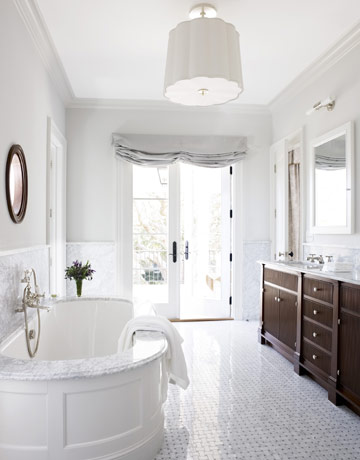
Transitional style.
With so many options in stone, porcelain and ceramic tile, we don't often think of the design possibilities using white. Using textures, varying scale, and changing the shades of white in tile and slabs, can create dramatic baths whose designs stand the test of time. Using accent hues in cabinetry, mirrors, and lighting, a white bath will be timeless.  With classic elements, these baths demonstrate how stunning simply white can be.
Classic and traditional.
Cottage casual and minimalist yet comfortable.
Classic and elegant with cabinetry as the accent hue.

May 12, 2011

Bathroom trends.

At a recent bathroom industry trade show, new trends and products were showcased.   A theme was clear when looking at products and their style, color and textures.


1) Traditional style reigns.  From faucets to cabinetry, classic styles remain the most popular. Function, however, as in faucets, shower doors and other items is more technological with hands-free faucets, air-assisted low flow shower heads, frame free glass shower doors, and neutral colors in counters and flooring.


2) Sleek, modern style is moving up in popularity. Whether you look at tubs,  toilets or shower fixtures, the lines are smoother and minimalist.  Chrome -without the negative manufacturing byproducts - is the finish of choice. 


3) Matte white is a new popular color.  For counters and tile it's a change from glossy sheens.  Even black - also  in a matte finish - is moving into popularity.


4) Gray is the new neutral.  The flexibility of the gray palette is outstanding.  Warm and cool grays are soft and the palette can be paired with whites, wood tones, and metal fixtures. 


5) Texture is in.  From damask inspired floor tiles to textured porcelain wall and floor tile, the look is custom yet serene.  Formal wall coverings with nubby surfaces are being used in bathrooms more often.  Traditional wainscot is making a resurgence and using new humidity tolerant paints makes it possible.